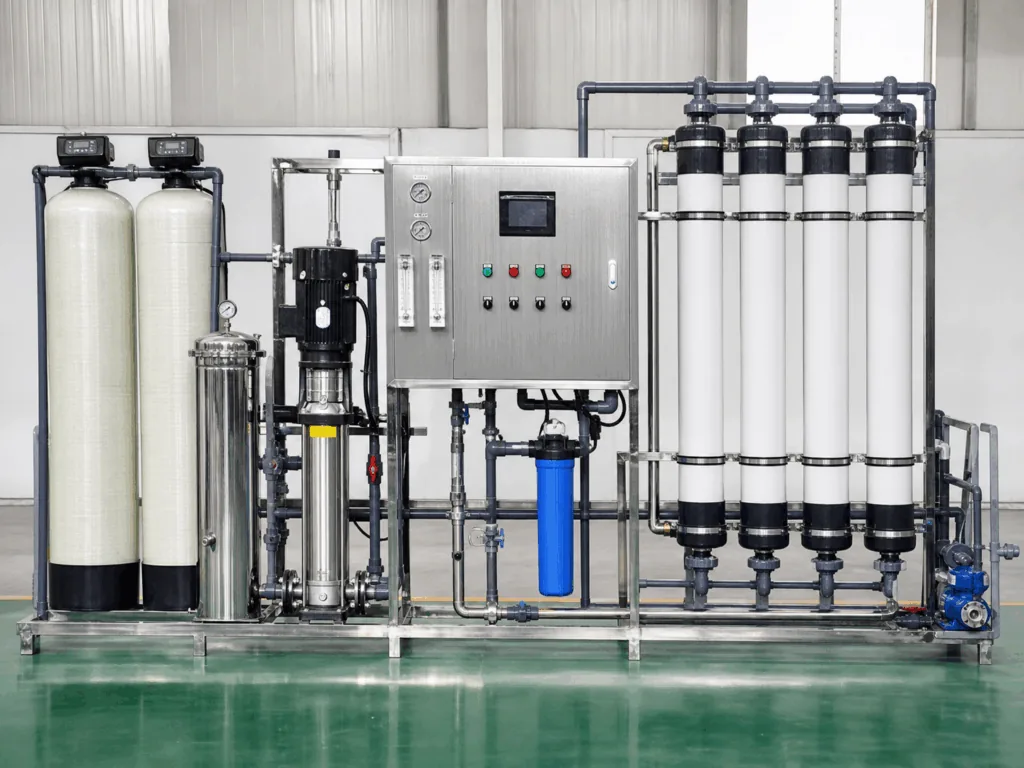
Process water support
- Industrial rinsing and cleaning
- Food processing support water
- Production process water preparation
- Water quality improvement before downstream use
Planning details
Please provide capacity required per hour or day, water source, target water quality, application, available installation space, voltage, and destination country.
What an industrial pure water system removes
An industrial pure water system is a water treatment system that uses reverse osmosis to reduce dissolved solids in your water. You should check your feed-water analysis and the water quality required at the point of use, because these determine whether additional treatment stages are needed for your application.
First, review TDS or conductivity alongside hardness, because a softener removes hardness while RO reduces dissolved solids. Second, treat the RO reference desalination rate of 95-99% as a reference parameter, and specify the water quality your process requires at the point of use. Third, select suitable membrane pretreatment to address scaling and fouling, with optional post-treatment assessed against your target. For example, a site assessing water treatment for an industrial electric steam generator should send its source-water analysis and the connected equipment’s water requirements before choosing the treatment arrangement.
How pure water differs from softened water
Pure water treatment is an RO-based process that reduces dissolved solids, while softening is an ion-exchange process that removes hardness. You should compare your equipment’s water requirements with both hardness and TDS, because removing calcium and magnesium does not mean that total dissolved solids have also been reduced.
First, establish whether your process needs hardness removal, dissolved-solids reduction or a treatment arrangement addressing both requirements. Second, assess membrane protection separately, because RO needs suitable filtration, softening or antiscalant dosing to avoid scaling and fouling. Third, compare the treatment duty with the required output; standard RO nominal capacities include 1 T/h and 2 T/h, with actual output dependent on feed-water quality and temperature. For example, a commercial laundry reviewing water for its steam equipment should compare the connected equipment’s requirements with the available water analysis before selecting softening or RO.
Which production processes need pure water
A process requiring pure water is an application whose specified water quality calls for dissolved-solids reduction through RO. You should use the requirements of your connected equipment and its point of use to establish the treatment need, rather than select a system from the industry name alone without checking.
First, send the water quality required by each connected process so the proposal can address your actual treatment duty. Second, identify the equipment using the treated water and explain whether those users operate simultaneously. Third, relate that demand to nominal capacity; standard RO models include 3 T/h and 4 T/h, although feed-water quality and temperature affect actual output. For example, a commercial laundry assessing water treatment for steam equipment should provide its equipment list, water source and operating pattern so the treatment requirement can be reviewed against the intended use.
How the process stages are put together
A pure water treatment train is an arrangement built around RO, with optional pretreatment and post-treatment selected for the target water quality. You should check the source-water analysis and point-of-use requirements together, because the stages needed to protect the membranes and meet your process requirements depend on those inputs.
First, review the reference sequence: quartz sand filtration, activated carbon filtration, antiscalant dosing, precision filtration, a high-pressure pump and the RO main unit. Second, confirm which pretreatment stages suit your water and whether post-treatment is needed for the specified use. Third, check the available inlet conditions; the RO reference raw-water inlet pressure is 0.1-0.3 MPa, and a raw-water pump is added when needed. For example, a site assessing an RO supply for an industrial steam generator should submit its water analysis and required outlet quality before the process stages are selected.
How to size a pure water system
Pure water system sizing is the selection of an RO output capacity against your required flow and water conditions. You should provide your operating demand, feed-water quality and water temperature, because a model’s nominal hourly output can differ from its actual output under the conditions at your own site.
First, state the treated-water flow your connected equipment requires and identify which users operate at the same time. Second, provide the source-water analysis, temperature and any seasonal changes so capacity can be assessed against your feed conditions. Third, check the electrical supply alongside output; the 0.25 T/h and 0.5 T/h reference RO models use 220 V / 50 Hz. For example, a commercial laundry assessing water for several steam users should send its equipment list and peak operating period with its water requirements before a nominal system capacity is selected.
What to send for a pure water proposal
A pure water proposal is a project-specific treatment selection based on your feed water, required output and target water quality. You should send the water analysis together with your connected equipment’s requirements, because neither the source-water results nor the nominal capacity alone defines the treatment arrangement your site needs.
First, send total hardness, TDS or conductivity, pH, chloride, iron and manganese, plus silica and turbidity where available. Second, identify the water source, temperature, seasonal variation, required flow and target quality at the point of use. Third, include your electrical supply and connected equipment; reference RO models of 1 T/h and above use 380 V / 50 Hz. For example, a site preparing a pure water proposal for industrial electric steam equipment should send its analysis and operating requirements to yeyiyulong@163.com so the treatment stages and capacity can be assessed together.
Frequently Asked Questions
What is an industrial pure water system?
An industrial pure water system uses RO as its core process to reduce dissolved solids. Pretreatment and post-treatment are optional and depend on the target water quality at your point of use. Selection requires your feed-water analysis, required output and the water requirements of your connected equipment.
What is the difference between softened water and pure water?
Softened water has had hardness removed through ion exchange, but softening does not reduce total dissolved solids. A pure water system uses RO to reduce dissolved solids. Your equipment’s water requirements determine the treatment needed, while the feed-water analysis helps establish suitable pretreatment for the RO membranes.
Which industries need pure water?
The need for pure water depends on the specified water quality of your process and connected equipment. For your site, establish whether dissolved-solids reduction is required. A commercial laundry assessing water for steam equipment should provide the equipment’s water requirements and source-water analysis before selecting a treatment system.
What process stages does a pure water system use?
RO is the core process, with optional pretreatment and post-treatment selected for your target water quality. The reference RO line includes quartz sand filtration, activated carbon filtration, antiscalant dosing, precision filtration, a high-pressure pump and the RO unit. A raw-water pump is added when needed for your supply.
How do I size a pure water system?
Start with your required treated-water flow and the water quality needed at the point of use. Send feed-water quality and temperature because actual RO output varies with these conditions. Identify connected equipment and simultaneous demand, then compare your requirements with the available nominal capacities and electrical supply.
What water analysis is needed for a pure water system?
Send total hardness, TDS or conductivity, pH, chloride, iron and manganese. Include silica and turbidity where available. Identify whether your supply is municipal, well or surface water, and provide its temperature and any seasonal variation. Add your target water quality so the treatment arrangement can be assessed.
Raw water assessment required Output customized RO core process available Pretreatment and downstream equipment optional